
Strengthening Connections
Youth and Provider Perspectives on Youth Running from Out-of-Home Placements
REPORT HIGHLIGHTS:
- Connectedness is run prevention, intervention, and aftercare.
- Youth run from out-of-home placements when they become dysregulated to try to get their needs met. They run to connectedness and familiarity.
- Youth have a predisposition to test boundaries and desire autonomy over their own lives. Opportunities for both are limited in out-of-home placements, so running can reflect these typical adolescent needs.
- Providers must follow prescribed protocols when a youth runs and overall feel they do not have the autonomy to locate a youth who has run from a placement.
- The degree of connectedness youth feel with providers has an impact on their ability to psychologically and physically regulate after returning from a run.
- Programmatic and systemic barriers make it difficult to prevent a run from occurring.
AUTHORS:
Kristin Myers, PhD, LPC, SSP
Congress Park Counseling and Consulting
Lexi Wimmer, MA, LPC, LAC
Doctoral Candidate, University of Northern Colorado
Kristin Klopfenstein, PhD
Director, Colorado Evaluation and Action Lab
Abstract
In the 2022 legislative session, lawmakers passed House Bill 22-1375 Concerning Measures to Improve the Outcomes for Those Placed in Out-Of-Home Placement. This statute required the Office of Colorado’s Child Protection Ombudsman to enter into an agreement with an institution of higher education to examine the issue of youth running away from out-of-home placements from a lived experience perspective. This report contains the results of five focus groups, two with out-of-home placement providers, and three with youth ages 12-17 currently residing in out-of-home placement. Providers and youth provided their perspectives on (1) What conditions led to running from an out-of-home placement? (2) What efforts were made to locate a child or youth after a running incident? (3) What services were provided to the child or youth after a running incident? and (4) What programmatic and systemic barriers make it difficult to prevent a run from occurring? In addition to the questions required by statute, the results also provide insight into what happens right before a running incident, the impact of childhood trauma on running behaviors, a lived experience perspective on prevention efforts, and the importance of connectedness for youth in out-of-home placements.
Table Of Contents
- Abstract
- Introduction
- Project Rationale and Description
- Project Rationale
- Project Description
- Methods
- Purpose of Qualitative Research Perspectives
- Sample
- Focus Group Protocol
- Key Findings
- What conditions led to running from an out-of-home placement?
- What efforts were made to locate a child or youth after a running incident?
- What services were provided to a child or youth after a run?
- What programmatic and systemic barriers make it difficult to prevent a run from occurring?
- Opportunities for Prevention: Consequences and Connectedness
- Conclusion
- Appendix A: Semi-Structured Interview Protocols for Youth and Providers
- Appendix B: Additional Focus Group Participant Quotes by Topic
- Appendix C: Coding Strategy
- Endnotes
Acknowledgements
This research was supported by the Office of Colorado’s Child Protection Ombudsman. The opinions expressed are those of the authors and do not represent the views of the State of Colorado, Congress Park Counseling and Consulting, the Office of Colorado’s Child Protection Ombudsman, or the University of Denver. Policy and budget recommendations do not represent the budget or legislative agendas of state agencies, the Governor’s Office, or other partners.
Thank you to our partners who provided subject matter expertise and guidance on this project: the Office of Colorado’s Child Protection Ombudsman, the Colorado Association of Family and Children’s Agencies, and the Timothy Montoya Task Force to Prevent Children from Running Away from Out-of-Home Placements. Thank you to the out-of-home placement providers and their staff for their time in participating in the focus groups and arranging for focus groups with youth participants. We would like to express deep gratitude to the youth in out-of-home placements for providing their perspectives and for sharing their lived experiences on this topic.
Data Sources
Data was collected through conducting five focus groups. Thank you to the Office of Colorado’s Child Protection Ombudsman, the Colorado Association of Family and Children’s Agencies, and the Timothy Montoya Task Force for assisting in finding focus group participants.
Suggested Citation
Myers, K., Wimmer, L., & Klopfenstein, K. (April 2023). Strengthening connections: Youth and provider perspectives on youth running from out-of-home placements (Report No. 23-05A). Denver, CO: Colorado Evaluation and Action Lab at the University of Denver.
Note on Language Regarding “Runaway”
The Timothy Montoya Task Force is working to develop common language that accurately reflects a child or youth’s experience on the topic of “runaway.” For the purposes of this report, language from House Bill 22- 1375 will be used to ensure required elements of the bill were fulfilled.
Introduction
Timothy Montoya was a 12-year-old residing in an out-of-home placement who was tragically hit and killed by a car in 2020 while on the run from an out-of-home placement. His death highlighted statewide concerns about the lack of consistent, prompt and effective responses to youth who run from out-of-home placements. In 2022, House Bill (HB) 22-1375 Concerning Measures to Improve the Outcomes for Those Placed in Out-of-Home Placement Facilities was passed in Timothy Montoya’s honor.
Timothy Montoya’s life ended tragically as a result of running from an out-of-home placement. Running from out-of-home placements is a common occurrence resulting in potentially dangerous situations such as being a victim of crime, injury, or death. The Office of Colorado’s Child Protection Ombudsman and professionals in the child protection field assert that Colorado is in a mental health state of emergency. The rise in children and youth mental health concerns in Colorado has caused concern for out-of-home treatment facilities, parents, child welfare agencies, and legislators. Stakeholders like these see a need for statewide quality assurance and accountability systems, and supports for children with runaway behaviors. Such tools are valuable for promoting quality services for high- needs children. With such tools in place, caregivers can feel assured that their child’s placement will be safe. Concerned stakeholders also value the importance of amplifying child and youth voices to enhance understanding of runaway behaviors.
“Not all kids run away because they’re necessarily bad kids or because they want to make bad decisions, but sometimes it’s because they don’t know what to do and they’re looking for help. …it’s not necessarily because they’re bad or that they want to make bad decisions but because they… trauma. They are looking for something, they’re looking for a way to get their needs met, and don’t know how to get those needs met. So, they’re trying whatever way they know how rather than trying a healthy, more positive manner.”
– Youth Focus Group Participant
The purpose of HB 22-1375 is to establish the Timothy Montoya Task Force to Prevent Children from Running Away from Out-of-Home Placements, which began in September 2022 and will meet for two years. One of the requirements of the Task Force is to analyze root causes of why children run away from placement in order to develop a consistent, prompt, and effective response for children who run away from placement and will also address the safety and well-being of children upon return to placement after a run.
Additionally, HB 22-1375 required the Office of Colorado’s Child Protection Ombudsman to enter into an agreement with an institution of higher education with experience in child welfare research to conduct focus groups with providers and youth in out-of-home placements to better understand the lived experience on this topic. The statute specifically requires the researcher to conduct focus groups with children and youth who have experienced out-of-home placement. The five focus groups were conducted in early 2023 across Colorado, and this report highlights the findings. Providers and youth provided their perspectives on (1) What conditions led to running from an out-of-home placement? (2) What efforts were made to locate a child or youth after a running incident? (3) What services were provided to the child or youth after a running incident? and (4) What programmatic and systemic barriers make it difficult to prevent a run from occurring? In addition to the questions required by statute, the results also provide insight into what happens right before a running incident, the impact of childhood trauma on running behaviors, a lived experience perspective on prevention efforts, and the importance of connectedness for youth in out-of-home placements.
Project Rationale and Description
Project Rationale
Children and youth who reside in residential treatment facilities often face significant behavioral health needs and are provided with critically important services to meet their complex needs in their out-of-home placements. Running away from out-of-home placements such as residential treatment facilities is common. While there are a variety of reasons a child may run from out-home-placement, running is a coping behavior. Prior research indicates children are either running to (access), or running from (avoidance of someone or something).
Running away can adversely affect children and youth in a multitude of negative ways including criminal victimization, sexual exploitation, physical and mental health problems, homelessness, and delinquent behavior. The most severe risk to children and youth who run away is the risk of dying from intentional or accidental means.
Project Description
This project provides critical data to inform the Task Force on the following primary questions related to youth who run from out-of-home placements:
1. What conditions led to running from an out-of-home placement?
2. What efforts were made to locate a child or youth after a running incident?
3. What services were provided to the child or youth after a running incident?
4. What programmatic and systemic barriers make it difficult to prevent youth from running from an out-of-home placement?
In addition to the questions required by statute, the results also provide insight into what happens right before a running incident, the impact of childhood trauma on running behaviors, a lived experience perspective on prevention efforts, and the importance of connectedness for youth in out-of-home placements.
Methods
Purpose of Qualitative Research Perspectives
The primary investigator (PI) used qualitative research methods to capture the lived experiences of children and youth as well as out-of-home services providers on the issue of youth running from out-of-home placements. Although public policies have a direct impact on the lives of children, youth, and service providers who experience running behaviors, their voices are rarely included in research.17, 18 Recent research has explored individual and societal factors that influence running behavior; however, the voices of the children and youth who reside in facilities and the providers who serve them have rarely been explored.
The data collected in this project establishes critical context for policy and practice recommendations. The narratives of the children and youth provide first-hand knowledge of what it is like to experience an out-of- home placement and the impact running incidents have on the child who runs as well as their peers. The service providers’ lived experience provides a comprehensive description of how they perceive running behaviors as well as the impact the run has on the individual child and facility as a whole. Amplifying youth and provider voices provides stakeholders and policymakers the opportunity to gain more understanding, empathy, and awareness.
Sample
A purposeful criterion-based sampling strategy was used to seek participants who are experts on the experiences of children and youth who run from out-of-home placement. The Office of Colorado’s Child Protection Ombudsman, the Colorado Association of Family and Children’s Agencies, and members of the Timothy Montoya Task Force provided a list of potential focus group participants, including children and youth up to age 22 and out-of-home placement providers.
Actual children and youth participants ranged in age from 12 to 17. The invitation to participate included children and youth up to 22 years of age; however, there was not representation in this project for children under age 12 or youth 18 to 22. While including voices of all ages would have been ideal, the ages in this sample are consistent with previous research that indicates adolescents ages 13 and over are most likely to run from placements.19 The participants had the ability to communicate verbally and the capacity to recount their experiences with running incidents in out-of-home placement programs. Youth focus group participants represented three out-of-home placement providers located in northern, front range, and southern Colorado.
Out-of-home service provider focus group participants represented facilities located in northern, Front Range, southeast, and southern Colorado. The focus groups included a variety of service roles within the facility including directors, supervisors, and direct care staff.
Focus Group Protocol
A semi-structured interview protocol was developed to facilitate a rich and robust description of experiences from the participants’ perspectives. This included 12 guiding questions for the youth and the providers that were directed toward the main purposes of the study and evaluation questions (see Appendix A). The focus group facilitator reflected participant experiences throughout the focus groups to check for accuracy of what was being said.
In qualitative research, data collection typically ends when saturation is reached, which means no new information is emerging. In this project, saturation was reached after two provider focus groups and three focus groups with children and youth.20 The focus groups were audio-recorded and transcribed into written form to ensure accuracy of participant quotes. The transcripts were used to code the data into overarching themes. In addition to the PI, two independent qualitative research coders each reviewed transcripts and codes to ensure accuracy of the PI’s initial findings.
Key Findings
Each section contains a summary of the narrative provided by the youth and provider focus groups. Direct quotes from the youth participants are in green and provider quotes are in brown. Appendix B provides additional direct quotes for each topic.
The PI began each focus group by asking youth questions from the semi-structured interview protocol about running. In each group youth asked, “you mean AWOLing?” The term AWOL was widely used as common terminology among youth to describe running incidents and behaviors. This term was used regardless of the out-of-home placement during the interviews.
Findings are organized according to each of the four primary questions.
1. What conditions led to running from an out-of-home placement?
Focus group participants indicated three conditions that led youth to run from their out-of-home placement.
- Running from the placement due to dysregulation from triggering events, disconnection from staff, and responses to previous trauma.
- Running to connectedness and familiarity.
- Running due to typical adolescent behavior.
Conditions that Led to a Run: Running From
Triggering events, disconnection with staff, and responses to previous trauma
Consistent with previous literature, provider and youth described instances where youth ran from a situation for a variety of reasons. Regardless of the reason for running from an out-of-home placement, children are typically dysregulated at the time of a run. Youth focus group participants describe being in a state of emergency, often described as “fight, flight, or freeze”, and are unable to access the parts of their brain that allows them to make rational decisions an understand consequences. Therefore, youth who are dysregulated are more likely to run from an out-of-home placement.
Dysregulated youth may experience physical symptoms such as increased heart rate, irregular breathing patterns, or the inability to think or perform simple tasks. Common reasoning is not available to youth in this state of functioning. They cannot think of consequences or foresee their actions as potentially dangerous. 21, 22 The youth and provider focus group participants described events that led up to the child dysregulating. Although youth and providers may view these situations differently, the same three underlying themes emerged about what makes a child at risk for dysregulation and therefore to running from an out-of-home placement: triggering events, disconnection with staff, and responses to previous trauma.
Triggering Events
Children in out-of-home placements have individualized treatment plans. These plans frequently change and that results in a change in the child’s daily life and expectations for the future (e.g., longer time in out-of- home placement, change in placement, or a change in their child welfare case). This can result in dysregulation and a potential running incident. Providers and youth had two different perceptions: youth who run after a phone call or visit from an external care provider like a caseworker or parole officer, and/or running after a phone call or visit from their family. Youth also indicated they ran, or thought more about running, after visiting family on a pass home.
Calls and visits from a member of their external provider team can result in a change in the child’s treatment trajectory or out-of-home placement plan. Providers cited these conversations as events that can trigger a youth running from placement. Provider participants also referred to incidents where a child was regulated until they received a phone call from their family. The call could be regarding something the youth is missing out on with their family while in the out-of-home placement, or an argument with a family member.

“In a lot of the cases, kids have to be alone to make phone calls with their professional. In a delinquency filing, an attorney will want to talk and want to do it alone. If they get bad news there, that’s one of the ways. When we get it right, we’re engaged, the programs engaged in the call. The stage is set nicely and we’re able to work with and through it, but when we don’t know, you know, a lot of times this is what happens.”
A Disconnection with Staff
Youth participants described feeling disconnected, unseen, or unheard as a reason for running from an out- of-home placement. Youth and providers also noted staff shortages prevent youth from getting what they need from staff. Youth participants often described themselves and their peers as “attention seeking” when they were not getting their psychological or physiological needs met due to a lack of staff time. Youth participants also described feeling unsafe or disconnected with some staff members based on their experiences in the placement.

“One reason why people like AWOL is because like, it’s just, you don’t want to be in the situation you’re in. And, like, sometimes, especially here, it gets really stressful with the staff and youth. Staff do a lot of stuff that makes, like, that makes us want to, like, not talk or not speak around people. And it’s just like, sometimes it’s hard to open up the staff or open up to youth because you don’t know what’s going on, or you don’t know who you’re with, like, you know. You don’t really want to be here. It’s just more or less, you want to have a – you don’t want to, like, spend the time here because, like, it’s just really hard.”

“In our facility, we would want to say that all of our staff are doing the right things. Sometimes, that wasn’t the case. Sometimes, kids walked away because they didn’t feel like staff were as caring as they should have been or were not able to provide the space that they needed; it’s a myriad of things.”
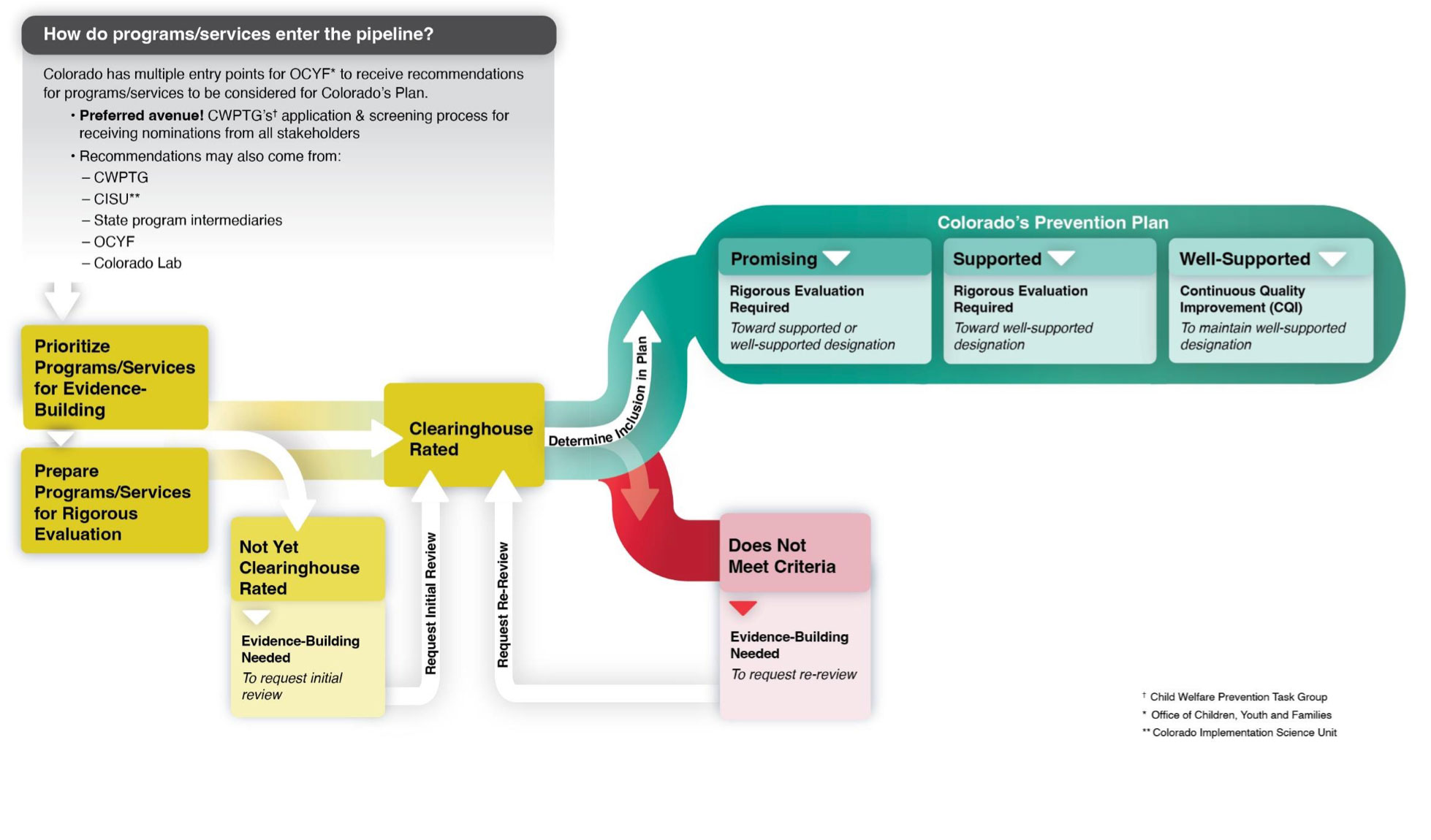
| Program / Service Name | Evidence Designation | Last Reviewed | Action Required | Colorado Status |
|---|---|---|---|---|
| Child First | Supported | May 2021 | Lorem ipsum dolor sit amet | Lorem ipsum dolor sit amet victous allegro nada |
| Foster Healthy Futures for Preteens | Supported | June 2022 | Lorem ipsum dolor sit ametLorem ipsum dolor sit amet | Lorem ipsum dolor sit amet |
| Trauma-Focused Cognitive Behavioral Therapy | Promising | June 2019 | Lorem ipsum dolor sit ametLorem ipsum dolor sit amet | Lorem ipsum dolor sit ametLorem ipsum dolor sit ametLorem ipsum dolor sit ametLorem ipsum dolor sit amet |
| Fostering Healthy Futures For Teens | Does not meet criteria | June 2022 | Lorem ipsum dolor sit ametLorem ipsum dolor sit amet | Lorem ipsum dolor sit |
| Lorem Ipsum | Not yet rated | N/A | Lorem ipsum dolor sit ametLorem ipsum dolor sit amet | Lorem ipsum dolor sit ametLorem ipsum dolor sit amet |
Appendix C: Coding Strategy Terms
Phenomenological methodology involves exploring lived experiences of people as experts in their own lives. This type of methodology involves taking a holistic view of the data to understand the phenomenon being studied, in this case lived experiences with running incidents. In this program evaluation process, the PI captured the essence of what it was like to experience a run personally, as a peer who runs, or from the perspective of the service provider. The coding process in this research approach involves the following methods: epoche, phenomenological reduction, horizontalization, imaginative variation, and synthesis of meanings and essence.1 Each of the following steps occur in order, as the steps are intended to build upon one another, and one cannot happen before the previous step is achieved.
Terms
-
Epoche
This first step means to refrain from holding dogmatic views of the phenomenon being studied. In order to accomplish this step, the PI and external coders evaluated any previously held biases, understandings, or judgements regarding running incidents and behaviors.
-
Phenomenological Reduction
The phenomenological reduction process involves viewing all participant statements in an open way and aiming to recognize any bias that may hinder the evaluators in fully understanding the participant experience. Methods used to address this were evaluator journals, listening to recorded interviews multiple times, and carefully reviewing interview transcripts.
-
Horizontalization
This process involves giving each participants’ statements equal importance by setting aside evaluator bias or opinion. To accomplish this, the evaluator reviewed transcripts independently and worked with external coders to evaluate accuracy.
-
Imaginative Variation
Each external coders read transcripts according to the codebook. The PI carefully considered the possible underlying causes or influences that may have impacted participants in their experiences with running from out-of-home placements. The PI and external coders selected salient participant statements to represent the textural essence of the phenomenon that was studied.
-
Synthesis of Meanings and Essences
This final step in phenomenology is intended to synthesize the meaning and essence through a rich description of the phenomenon. This step is represented in the results section by integrating participant quotes.